
Capital Gains Tax: The Federal and California Rules for a Sale
Capital gains tax is the income tax you owe on the profit from selling an asset, and for Californians it comes in two layers that work differently. The federal government rewards holding an asset longer with lower rates, while California taxes every gain as ordinary income no matter how long you held it. This article explains both layers, the current rates and thresholds, the home sale exclusion that shelters much of a residence's gain, and the basis rules that decide how big the gain is in the first place. It also draws the line between capital gains tax and Proposition 19, and defines the key terms. Every source linked at the end is a government page.
What Capital Gains Tax Is
Capital gains tax is the income tax on the profit from selling a capital asset, such as a home, stock, or other investment. The taxable gain is the sale price minus your basis, which is roughly what you paid plus certain improvements. Sell for more than your basis and you have a gain; sell for less and you have a loss, which can offset gains. Two governments tax the same gain: the federal government through the IRS, and California through the Franchise Tax Board. Each applies its own rules to the same sale, so you plan for both at once.
The Federal Rules: Holding Period Sets the Rate
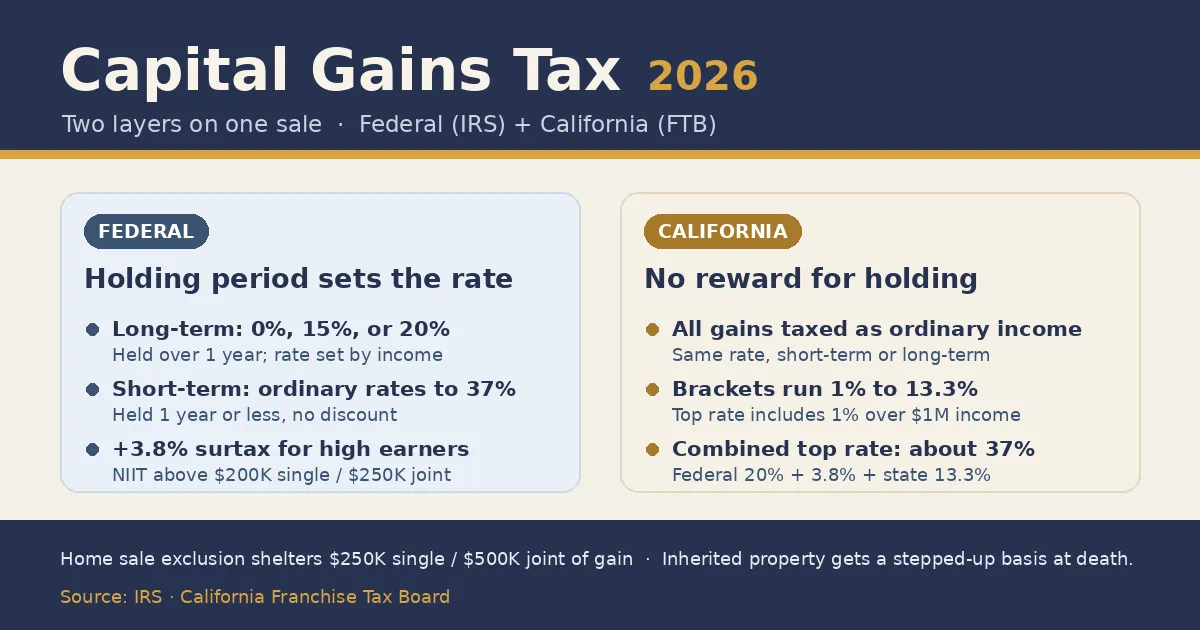
Federal law splits gains by how long you held the asset. A short-term gain, on an asset held one year or less, is taxed at your ordinary income rates, which run up to 37 percent. A long-term gain, on an asset held more than one year, gets lower rates of 0, 15, or 20 percent, based on your taxable income. For 2026, a single filer pays 0 percent on long-term gains up to $49,450 of taxable income, 15 percent up to $545,500, and 20 percent above that. For a married couple filing jointly, the breakpoints are $98,900 and $613,700. High earners also owe the net investment income tax, a 3.8 percent surtax on investment income once modified adjusted gross income passes $200,000 for a single filer or $250,000 for a joint return. These bracket thresholds adjust for inflation each year, so confirm the current figures for the year you sell.
The California Rules: No Reward for Holding
California takes a simpler and harsher approach. The state has no special capital gains rate, so every gain, short-term or long-term, is added to your other income and taxed at the regular brackets, which run from 1 percent up to 12.3 percent. Income over $1 million also pays an extra 1 percent mental health services tax, making the state's top rate 13.3 percent. Holding an asset for decades earns no state discount. Stack the two layers and a top-bracket Californian can owe roughly 37 percent combined on a large gain: 20 percent federal, 3.8 percent surtax, and 13.3 percent state. A large gain can also push the rest of your income into higher state brackets, since California treats the gain exactly like salary.
The Home Sale Exclusion
One shelter softens both layers for a home you live in. Under federal Section 121, you can exclude up to $250,000 of gain from the sale of your main home, or up to $500,000 on a joint return, if you owned and lived in the home for at least two of the five years before the sale. California follows this exclusion, so the sheltered gain escapes both federal and state tax. The exclusion applies to a principal residence, not to a rental or vacation home, and any gain above the exclusion is taxed under the rules above.
Basis Decides the Size of the Gain
Before any rate applies, the basis rules decide how much gain exists, and two of them matter most for family property. The stepped-up basis rule helps heirs: property received at the owner's death takes a new basis equal to its market value on the date of death, which usually erases the gain built up during the owner's life. A child who inherits a long-held California home and sells soon after may owe little or no capital gains tax. The carryover basis rule cuts the other way: property gifted during the owner's life keeps the owner's original low basis, so the recipient carries the built-in gain and can owe a large tax on a later sale. This contrast is why many families hold appreciated property until death rather than gifting it early.
Capital Gains Tax Is Not Proposition 19
Keep the two taxes separate, because mixing them up leads to costly mistakes. Capital gains tax is an income tax, owed once, when you sell, and calculated from your basis. Proposition 19 governs property tax, owed every year, and decides whether an inherited or replacement home is reassessed. The two can point in opposite directions: an heir might receive a full stepped-up basis for income tax while losing the low property tax base under Proposition 19, or keep the low property tax base while facing capital gains tax on a later sale. Analyze each tax on its own before deciding to keep, sell, or gift a property.
The Key Terms
Three terms carry this topic, each defined here with a government reference.
Capital gains tax: The income tax owed on the profit from selling an asset, measured from its basis, which the stepped-up basis can greatly reduce for inherited property. (https://www.irs.gov/taxtopics/tc409)
Stepped-up basis: An income tax rule that resets an inherited home's cost basis to its market value at the date of death, reducing capital gains tax on a later sale. (https://www.irs.gov/publications/p551)
Carryover basis: The rule that a home gifted during the giver's life keeps the giver's original cost basis, so the recipient inherits the built-in gain. (https://www.irs.gov/faqs/interest-dividends-other-types-of-income/gifts-inheritances/gifts-inheritances)
Further Reading From Government Sources
IRS Topic No. 409, Capital Gains and Losses explains the federal short-term and long-term rules and the current rate thresholds.
IRS Publication 551, Basis of Assets covers how to figure basis, including for inherited and gifted property.
IRS Publication 523, Selling Your Home details the $250,000 and $500,000 home sale exclusion and its ownership and use tests.
California Franchise Tax Board: Capital gains and losses explains that California taxes capital gains as ordinary income with no special rate.
California Franchise Tax Board: Income from the sale of your home covers California's treatment of gain from selling a residence.
This article is a plain-language guide, not tax advice. Rates, thresholds, and exclusions change over time and depend on your full tax picture, so confirm your numbers with a qualified tax advisor before you sell, gift, or plan around a large gain.


Bart Hubbard / Real Estate Associate at HomeSmart ICARE Realty | DRE #01815497
1891 E Roseville Pkwy #180 • Roseville, CA 95661 • Phone: 916.993.8680
Copyright 2026
Nothing on this page is legal or tax advice. Procedures and dollar thresholds change, and every estate is different. Please confirm the specifics of your situation with a licensed California attorney.