
Claimant: Who Can File a Proposition 19 Tax-Base Transfer
Every Proposition 19 tax-base transfer starts with a claimant, the property owner who files the claim and must personally qualify for the benefit. This article explains what a claimant is, the three eligibility tests and why you need to meet only one, the ownership and residency requirements attached to the role, and how married couples qualify through one spouse. It also covers which form the claimant files, where and when to file it, and how a claimant differs from an authorized representative who signs on the owner's behalf. Every source linked at the end is a government page.
What a Claimant Is
The claimant is the property owner who files for a Proposition 19 tax-base transfer and must personally meet one of the law's three eligibility tests. The word matters because the benefit attaches to a person, not just a property. The claimant signs the claim form under penalty of perjury, certifying their eligibility and the facts of the sale and purchase. If the claim is granted, the transfer also counts against that claimant's lifetime limit, so who serves as the claimant is a real decision, not a formality.
Three Tests, and You Need Only One
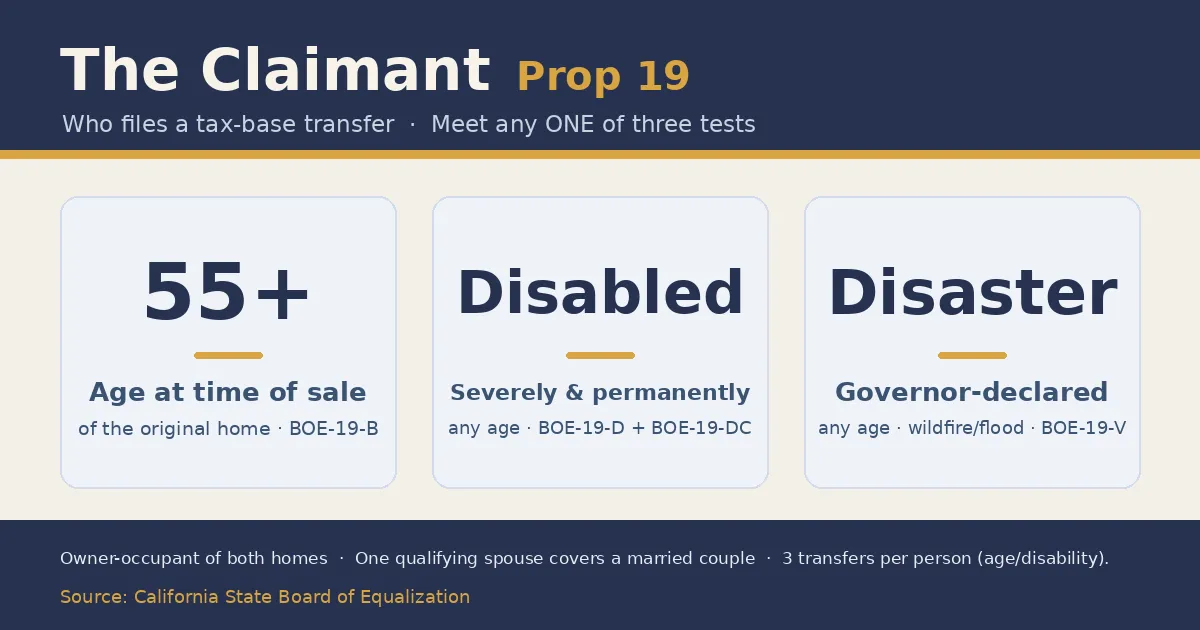
Proposition 19 opens the transfer to three groups, and the claimant needs to fit just one of them. The first test is age: the claimant must be at least 55 years old on the date the original home sells. The second test is disability: a claimant of any age qualifies if they are severely and permanently disabled, confirmed by a physician's Certificate of Disability, and the move accommodates or eases the disability. The third test is disaster: a claimant of any age qualifies if a Governor-declared wildfire or natural disaster substantially damaged or destroyed their home. Meeting two tests adds nothing; one is enough.
The Owner and Resident Requirements
Beyond the eligibility test, the claimant must hold the right relationship to both homes. The claimant must be an owner of the original home, and that home must have been their principal residence, generally shown by the homeowners' exemption or the disabled veterans' exemption. The claimant must then own and occupy the replacement home as their principal residence too. A person cannot claim the transfer on a rental they own, and cannot carry a base to a house they will not live in. In short, the claimant is an owner-occupant on both ends of the move.
Married Couples: One Qualifying Spouse Carries the Household
Only one spouse on title needs to meet an eligibility test for the household to qualify. If one spouse is 56 and the other is 52, the couple can transfer their tax base, because the older spouse serves as the claimant. One detail deserves attention: the transfer then counts against the qualifying spouse's lifetime limit of three, which is tracked per person rather than shared as a household pool. Since each spouse who qualifies has their own three transfers, a couple planning several moves over the years can think about which spouse claims each one.
What the Claimant Files, Where, and When
The claimant files the state claim form that matches their eligibility test: form BOE-19-B for age 55 or older, form BOE-19-D with the physician-signed BOE-19-DC for disability, or form BOE-19-V for a disaster. The claim goes to the assessor in the county where the replacement home sits, after both the sale and the purchase are complete and the claimant is living in the new home. This is not handled through escrow. Filing within three years of buying or building the replacement secures full retroactive relief; filing later still works but only going forward, forfeiting the years in between. Filing early, within a few months of settling in, is the safe habit.
Claimant Versus Authorized Representative
The claimant is the person who qualifies; the authorized representative is someone allowed to act for them. An attorney or accountant holding a valid power of attorney can sign and file the claim on the claimant's behalf, but the representative does not need to be 55 or disabled, because eligibility always rests with the claimant, the owner. A real estate agent, by contrast, can help gather documents but cannot file the claim without a power of attorney. The distinction keeps the roles straight: the claimant qualifies and bears responsibility for the claim, and a representative merely carries out the filing.
The Key Terms
Claimant: The property owner who files for a Proposition 19 tax-base transfer and must personally meet one of the three eligibility tests. (https://www.boe.ca.gov/prop19/#Transfers)
Lifetime limit: The cap of three tax-base transfers a qualifying person may use over their life, tracked per individual rather than per household. (https://www.boe.ca.gov/prop19/#Transfers)
Further Reading From Government Sources
California State Board of Equalization: Proposition 19 covers base-year-value transfers, eligibility, and answers to common claimant questions.
BOE property tax forms for county assessors lists the state-prescribed claim forms, including BOE-19-B, BOE-19-D, BOE-19-DC, and BOE-19-V.
BOE list of California county assessors helps you find the assessor for the county where your replacement home sits, which is where the claim is filed.
This article is a plain-language guide, not legal or tax advice. Eligibility details and filing procedures can vary in practice by county, so confirm your situation with the assessor in your replacement home's county or a qualified professional before you file.


Bart Hubbard / Real Estate Associate at HomeSmart ICARE Realty | DRE #01815497
1891 E Roseville Pkwy #180 • Roseville, CA 95661 • Phone: 916.993.8680
Copyright 2026
Nothing on this page is legal or tax advice. Procedures and dollar thresholds change, and every estate is different. Please confirm the specifics of your situation with a licensed California attorney.