
Proposition 19: California's 2020 Property Tax Trade
Proposition 19 changed California property taxes in two opposite directions at once. It gave older, disabled, and disaster-affected homeowners a generous new right to move their low tax base anywhere in the state, and it took away most of a family's ability to pass that low tax base to heirs. This article explains both halves, gives the key dollar figure and deadlines, and defines every key term that comes from Proposition 19, so you can read your county's forms and notices with confidence. Every source linked at the end is a government page.
What Proposition 19 Did
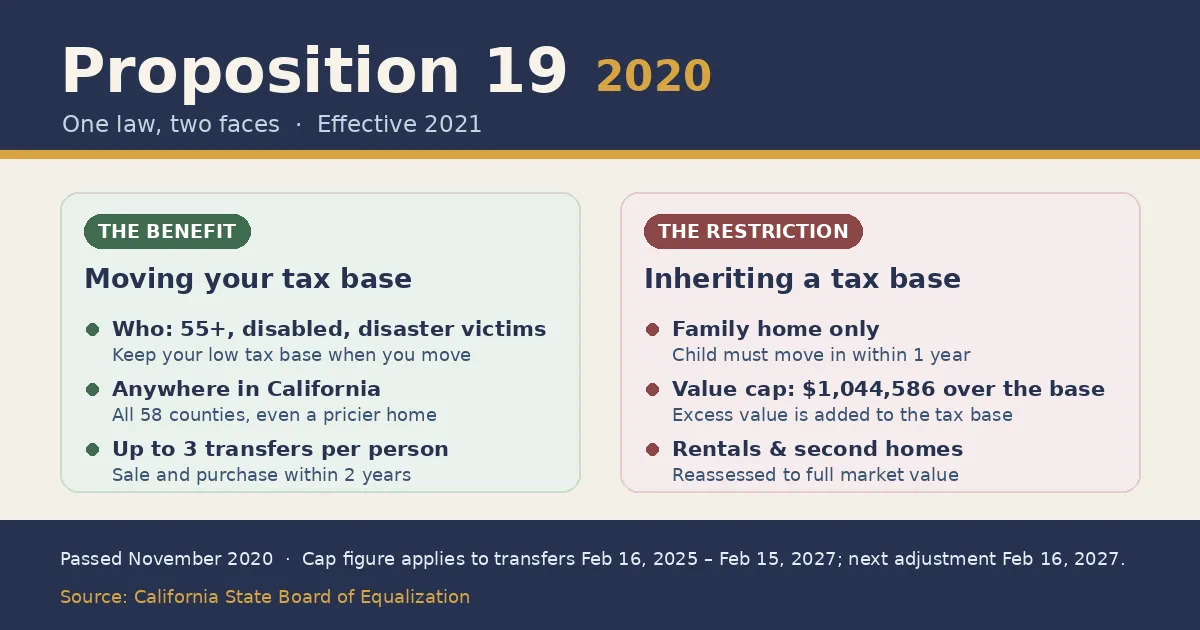
California voters passed Proposition 19 in November 2020, amending the state Constitution, and its rules took effect in 2021. The law does two things that pull in opposite directions. The benefit half helps people move: an eligible homeowner can carry the low taxable value of their current home to a replacement home anywhere in California, even a more expensive one. The restriction half limits inheritance: a child now keeps a parent's low tax base only on the parent's family home, and only if the child moves in within one year. Rentals, second homes, and commercial property lose the protection entirely and are reassessed to market value when they pass down.
The Benefit Half: Moving Your Tax Base
Three groups qualify to move a tax base: homeowners age 55 or older, people who are severely and permanently disabled, and victims of a Governor-declared wildfire or natural disaster. The home you leave must be your principal residence, and the replacement must become one too. The math compares the two homes' market values. If the new home costs the same or less, your low base transfers unchanged. If it costs more, you keep your low base and add only the difference in price. The sale and the purchase must fall within two years of each other, in either order, and owners who qualify by age or disability may use the benefit up to three times in a lifetime. You file your claim with the assessor in the county where the replacement home sits, and filing within three years of the purchase secures full retroactive relief.
The Restriction Half: Inheriting a Home
For inherited property, Proposition 19 narrowed a once-generous rule to a single case. The property must have been the parent's principal residence, and the child must move in, make it their own principal residence, and claim the homeowners' exemption within one year of the transfer. Even then, a value cap applies: the home keeps its full low base only up to its factored base year value plus an indexed amount, currently $1,044,586 for transfers from February 16, 2025 through February 15, 2027. Value above that limit is added to the base. A family farm gets the same protection without anyone having to live on it. Everything else, including rentals, vacation homes, and commercial buildings, is reassessed to full market value.
The Key Terms That Come From Proposition 19
A California property tax glossary is full of terms that trace directly to Proposition 19, each backed by a Proposition 19 reference from the State Board of Equalization. Grouped by which half of the law they belong to, here is every one.
Terms on the moving side
Proposition 19: The 2020 California constitutional amendment that expanded tax-base transfers for eligible homeowners and restricted the pass-down of a low tax base to heirs. (https://www.boe.ca.gov/prop19/)
Tax base transfer: The act of carrying a home's low taxable value to a replacement home, so the owner keeps a low tax bill after moving. (https://www.boe.ca.gov/prop19/#Transfers)
Portability: The general term for a tax base being movable from one home to another rather than lost at a sale. (https://www.boe.ca.gov/prop19/)
Claimant: The property owner who files for a Proposition 19 tax-base transfer and must personally meet one of the three eligibility tests. (https://www.boe.ca.gov/prop19/#Transfers)
Severely and permanently disabled: A qualifying disability, confirmed by a physician, that lets an owner of any age transfer a tax base when the move accommodates or eases the disability. (https://www.boe.ca.gov/prop19/#Transfers)
Full cash value: The market value of a home, meaning what it would sell for on the open market, which is the figure the assessor compares between the old and new homes. (https://www.boe.ca.gov/prop19/)
Adjusted full cash value: The original home's market value after the timing cushion is applied, treated as 100, 105, or 110 percent depending on when the replacement is bought. (https://www.boe.ca.gov/prop19/)
Partial relief: The outcome when a replacement home costs more, where the owner keeps the low base and adds only the difference in value rather than losing the benefit. (https://www.boe.ca.gov/prop19/#Transfers)
Intercounty transfer: A tax-base transfer where the replacement home is in a different California county than the original home, which Proposition 19 allows across all 58 counties. (https://www.boe.ca.gov/prop19/#Transfers)
Lifetime limit: The cap of three tax-base transfers a qualifying person may use over their life, tracked per individual rather than per household. (https://www.boe.ca.gov/prop19/#Transfers)
Two-year window: The requirement that the sale of the original home and the purchase or construction of the replacement home occur within two years of each other, in either order. (https://www.boe.ca.gov/prop19/#Transfers)
Retroactive relief: The full benefit granted when a claim is filed within three years, applying the transferred base back to the date the owner became eligible. (https://www.boe.ca.gov/prop19/#Transfers)
Prospective relief: The reduced benefit granted when a claim is filed after three years, applying the transferred base only going forward and forfeiting the earlier years. (https://www.boe.ca.gov/prop19/#Transfers)
Terms on the inheritance side
Intergenerational transfer: A transfer of property from parents to children, or in some cases from grandparents to grandchildren, which Proposition 19 reassesses unless strict conditions are met. (https://www.boe.ca.gov/pdf/pub801.pdf)
Intergenerational transfer exclusion: The Proposition 19 rule that lets a low tax base survive a transfer between parent and child, or grandparent and grandchild, only under the narrowed family-home conditions. (https://www.boe.ca.gov/prop19/#Exclusions)
Reassessment exclusion: A rule that lets a transfer happen without triggering a new market-value assessment, which Proposition 19 preserved only in a narrow form for inherited family homes. (https://www.boe.ca.gov/prop19/#Exclusions)
Principal residence: The home a person actually lives in as their main home, which is the only kind of property that can qualify for the narrowed inheritance exclusion. (https://www.boe.ca.gov/prop19/#Exclusions)
Family home: Under Proposition 19, the parent's or grandparent's principal residence, the only property type that can keep a low tax base when inherited, and only if the heir moves in. (https://www.boe.ca.gov/pdf/pub801.pdf)
Family farm: Real property used for agriculture, meaning land under cultivation, used for pasture or grazing, or used to produce an agricultural commodity, which can keep its low base when inherited without anyone living on it. (https://www.boe.ca.gov/pdf/pub801.pdf)
Value limit: The ceiling below which an inherited family home keeps its full low base, equal to the factored base year value plus the indexed exclusion amount. (https://www.boe.ca.gov/prop19/)
Indexed exclusion amount: The inflation-adjusted figure added to the base to set the value limit, currently $1,044,586 for transfers from February 16, 2025 through February 15, 2027. (https://www.boe.ca.gov/news/2025/nr-25-02.htm)
House price index adjustment: The every-other-year recalculation the State Board of Equalization uses to raise the indexed exclusion amount, based on a California house price index. (https://www.boe.ca.gov/news/2025/nr-25-02.htm)
Partial reassessment: The outcome when a qualifying home exceeds the value limit, where only the value above the limit is added to the low base rather than the whole home being reassessed. (https://www.boe.ca.gov/prop19/)
Full reassessment: The reset of a property's taxable value to current market value on transfer, which applies to inherited rentals, second homes, and other non-qualifying property. (https://www.boe.ca.gov/prop19/)
Terms on the filing side
Supplemental assessment: A mid-year reassessment the county makes when a property's value changes, which produces a separate supplemental tax bill to adjust the account. (https://www.boe.ca.gov/prop19/)
BOE-266: The Claim for Homeowners' Property Tax Exemption, the form an heir files to show the inherited home is their principal residence. (https://www.boe.ca.gov/prop19/)
Why Proposition 19 Still Matters
Proposition 19 did not replace Proposition 13; it changed what families can do with the low tax base Proposition 13 creates. For an eligible owner thinking about moving, the law removes the old penalty for relocating. For a family planning an inheritance, the law makes the outcome depend on decisions made in advance: which property passes, to whom, and whether an heir will genuinely live in it. The dollar figures shift over time, since the State Board of Equalization adjusts the indexed exclusion amount every other year, with the next change due February 16, 2027. So confirm the current figure for the year of your transfer before you run the numbers.
Further Reading From Government Sources
California State Board of Equalization: Proposition 19 is the state's central page for both the base-year-value transfer and the intergenerational exclusion, with forms and answers to common questions.
BOE Publication 801, Intergenerational Transfers explains the family home and family farm rules for parent-child and grandparent-grandchild transfers.
BOE news release on the indexed exclusion amount announces the current $1,044,586 figure and the adjustment schedule.
BOE property tax forms for county assessors lists the state-prescribed Proposition 19 claim forms, including BOE-19-B, BOE-19-P, BOE-19-G, and BOE-266.
This article is a plain-language guide, not legal or tax advice. Proposition 19 has strict deadlines, and its dollar figures change over time, so confirm the current rules with your county assessor or a qualified professional before you act.


Bart Hubbard / Real Estate Associate at HomeSmart ICARE Realty | DRE #01815497
1891 E Roseville Pkwy #180 • Roseville, CA 95661 • Phone: 916.993.8680
Copyright 2026
Nothing on this page is legal or tax advice. Procedures and dollar thresholds change, and every estate is different. Please confirm the specifics of your situation with a licensed California attorney.