
Probate: How California Settles an Estate, and Why Families Plan Around It
Probate is the court process for settling a deceased person's estate, and in California it is slow, public, and expensive enough that avoiding it is a central goal of estate planning. This article explains what probate does, what it costs under California's statutory fee schedule, which property skips probate on its own, and the shortcuts available for smaller estates and modest homes. It also covers why a living trust is the main tool for avoiding probate, and one deadline probate does not pause: the Proposition 19 one-year clock. Every source linked at the end is a government page.
What Probate Is
Probate is the process a California Superior Court uses to settle a deceased person's estate. The court confirms whether a will is valid, appoints a personal representative, called an executor when named in a will or an administrator when there is no will, and supervises the work of settling the estate. That work follows a set order: gather and inventory the assets, have them appraised, notify and pay creditors, resolve any disputes, and distribute what remains to the people entitled to it. If the person left no will, California's intestate succession law decides who inherits.
What Probate Costs and How Long It Takes
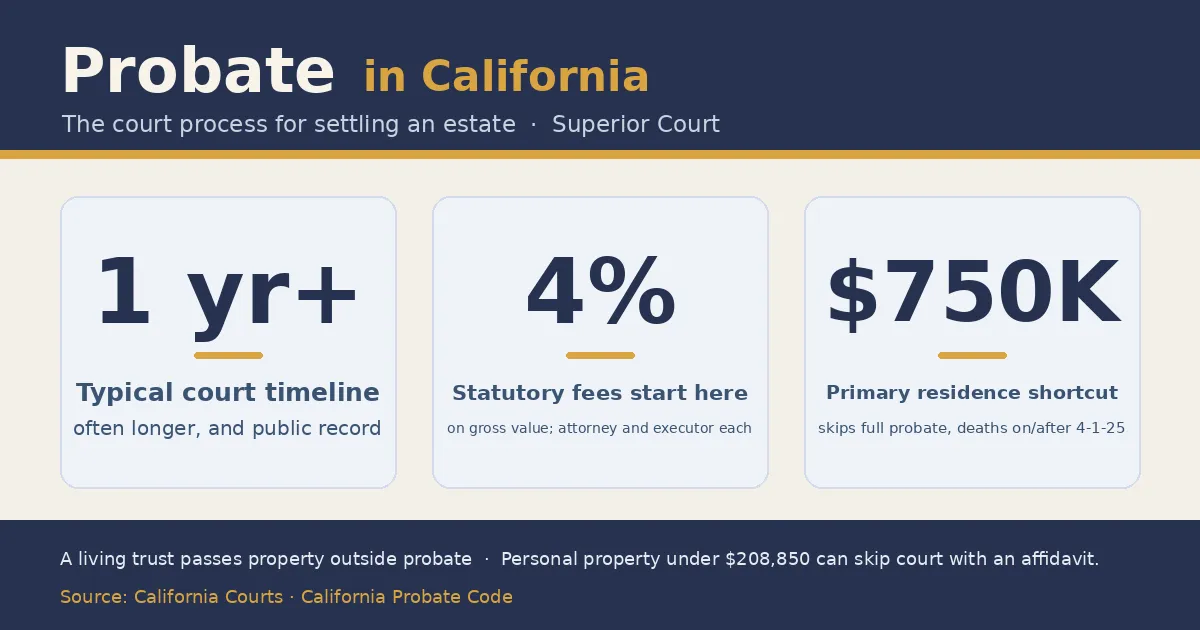
Probate in California is expensive because the fees are set by statute and based on the estate's gross value, before subtracting debts like a mortgage. Under Probate Code section 10810, the attorney for the estate earns 4 percent of the first $100,000, 3 percent of the next $100,000, 2 percent of the next $800,000, and 1 percent of the next $9 million. The personal representative may claim the same schedule. So a home worth $1 million generates a statutory fee of $23,000 for the attorney, and potentially another $23,000 for the representative, even if the home carries a large mortgage. Probate is also slow, commonly running around a year and often longer, and the filings are public record, so anyone can read what the estate held and who received it.
Property That Skips Probate on Its Own
Not everything a person owns goes through probate. Some property passes directly to a survivor or a named beneficiary by its own terms. Property held in joint tenancy passes to the surviving joint tenant. Community property with right of survivorship passes to the surviving spouse. Accounts with a named beneficiary, such as retirement accounts, life insurance, and payable-on-death bank accounts, go straight to the beneficiary. And property held in a living trust passes under the trust, outside probate entirely. Probate applies to what is left: property the person held in their own name alone, with no beneficiary and no survivorship right.
Shortcuts for Small Estates and Modest Homes
California offers simplified procedures that let smaller estates skip full probate, with dollar limits that depend on the date of death. For deaths on or after April 1, 2025, heirs can collect personal property, such as bank accounts, with a simple affidavit and no court case when the qualifying property totals $208,850 or less, after a 40-day wait. A newer law, effective the same date, lets heirs transfer the deceased person's primary residence worth $750,000 or less through a streamlined court petition instead of full probate. Because these figures adjust over time, check the current amounts on Judicial Council form DE-300 before relying on them. If the home is worth more than the limit, or the property does not fit a shortcut, full probate is the default.
Why a Living Trust Is the Main Way Around Probate
A revocable living trust avoids probate because property titled in the trust never sits in the deceased person's individual name. When the person dies, the successor trustee steps in and distributes the property under the trust's instructions, privately and without court supervision or the statutory fee schedule. For a California family whose home alone can exceed every shortcut limit, this is the reason living trusts are so common. One caution keeps the trust honest: it only works for property actually transferred into it. A home never retitled into the trust still faces probate, so funding the trust matters as much as signing it.
A Note on Carryover Basis
How property passes also affects income tax, through a rule called carryover basis. A home gifted during the owner's life keeps the owner's original cost basis, so the recipient carries the built-in gain and may owe large capital gains tax when they sell. A home received at death works the other way: its basis steps up to market value on the date of death, which usually erases the gain built up during the owner's life. This is one reason many families hold appreciated property until death rather than gifting it early, whether or not the estate goes through probate. Probate and basis are separate questions: a living trust avoids probate, but the basis outcome depends on whether the home passes during life or at death. The IRS explains how to determine the basis of gifted and inherited property in its gifts and inheritances guidance.
What Probate Does Not Change
Two rules from elsewhere in tax law run on their own schedules, and probate does not alter either one. First, Proposition 19's one-year clock for an inherited family home runs from the date of death, not from the end of probate. A child who waits for probate to close before moving in and claiming the homeowners' exemption can lose the low property tax base while the court case drags on. Second, avoiding probate with a living trust does not avoid Proposition 19: passing a home through a trust is still a change in ownership, with the same move-in conditions. A trust controls how property passes; it does not shield the property from reassessment.
Further Reading From Government Sources
California Courts Self-Help Guide: Property after someone dies walks through probate, who handles it, and the transfer options step by step.
California Probate Code section 10810 sets the statutory attorney fee schedule for probate.
California Probate Code section 13100 is the small estate affidavit law for collecting personal property without probate.
California Probate Code section 13151 is the petition procedure for transferring a primary residence without full probate.
Judicial Council form DE-300, Maximum Values for Small Estate Set-Aside and Disposition of Estate Without Administration lists the current dollar limits by date of death.
This article is a plain-language guide, not legal advice. Probate procedures and dollar limits change over time and can vary in practice by county, so confirm your situation with the court's self-help resources or a qualified California attorney before you act.


Bart Hubbard / Real Estate Associate at HomeSmart ICARE Realty | DRE #01815497
1891 E Roseville Pkwy #180 • Roseville, CA 95661 • Phone: 916.993.8680
Copyright 2026
Nothing on this page is legal or tax advice. Procedures and dollar thresholds change, and every estate is different. Please confirm the specifics of your situation with a licensed California attorney.