
Proposition 13: California's 1978 Property Tax Cap
Proposition 13 is the foundation of California's property tax system, and almost every other property tax rule builds on it. This article explains what Proposition 13 did, how it sets a property's starting value and limits how fast that value can rise, and when the value resets to today's market price. It then defines the key terms that come straight from Proposition 13, so you can read the rest of your property tax paperwork with confidence. Every source linked at the end is a government page.
What Proposition 13 Did
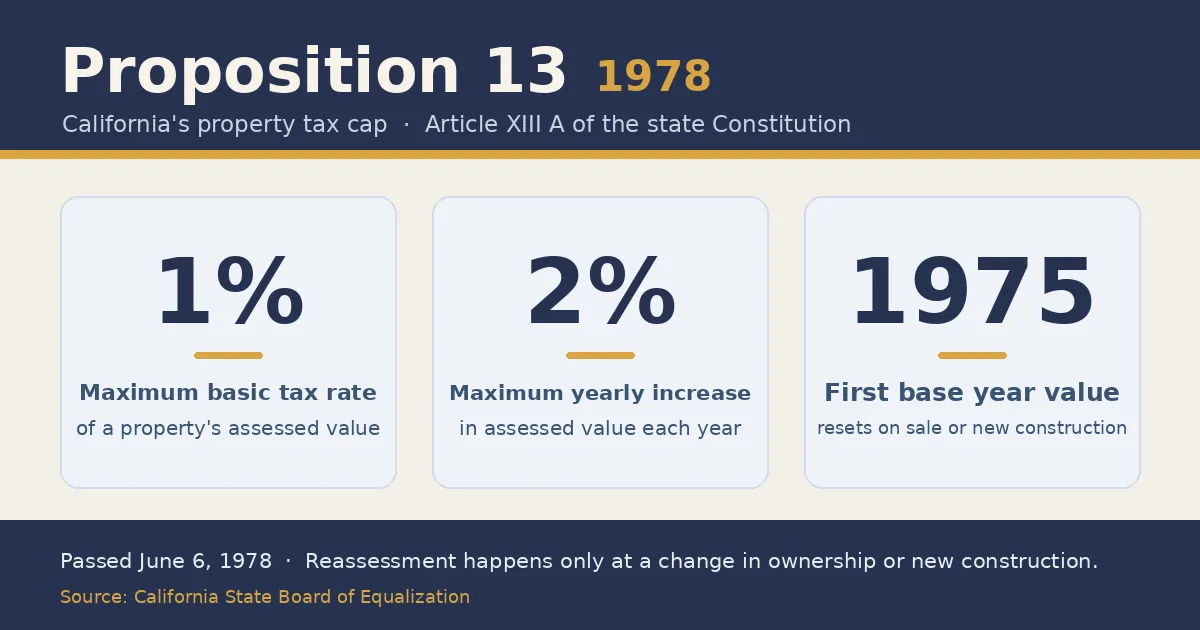
California voters passed Proposition 13 in June 1978, adding Article XIII A to the state Constitution. It replaced an older system of unpredictable tax increases with three firm rules that still govern property taxes today. First, it caps the basic property tax rate at one percent of a property's assessed value, though local voters can add small amounts for approved bonds. Second, it limits how fast the assessed value can rise, to no more than two percent a year, or the rate of inflation, whichever is lower. Third, it sets each property's starting taxable value, called the base year value, at its 1975 level or at the price paid when the property is later bought or built.
How the Starting Value Works
Proposition 13 changed the basis of the whole system. Before 1978, tax followed a property's current market value, which could jump without warning. After 1978, tax follows what the owner paid to acquire the property, raised by no more than two percent a year. Experts call this an acquisition value system. The effect grows over time, because California market values usually climb faster than two percent a year. So a long-time owner builds a widening gap between a low taxable value and a high market value, and pays tax on the low figure.
When the Value Resets
The low taxable value does not last under every condition. Proposition 13 built in two events that reset a property's value to current market value. The first is a change in ownership, such as a sale, gift, or inheritance. The second is new construction, such as adding a room or building a new structure. When either happens, the assessor performs a reassessment and sets a new base year value at the current market price. This is why a new buyer usually pays far more tax than the seller did, even on the same home.
The Key Terms That Come From Proposition 13
Several terms in a California property tax glossary trace directly back to Proposition 13, and each one relies on a Proposition 13 reference from the State Board of Equalization or a county assessor. Knowing them makes every tax notice easier to read.
Proposition 13: The 1978 California constitutional amendment that caps the property tax rate at one percent of assessed value and limits yearly increases in assessed value to two percent. (https://www.boe.ca.gov/proptaxes/proptax.htm)
Assessed value: The dollar value the county assessor uses to calculate your property tax, which under Proposition 13 is based on your purchase price rather than current market value. (https://www.boe.ca.gov/pdf/pub800-10.pdf)
Base year value: The starting taxable value assigned to a property, set either at its 1975 level or at the price paid when it was most recently bought or newly built. (https://www.boe.ca.gov/pdf/pub800-10.pdf)
Factored base year value: The base year value after it has been raised each year by the allowed inflation adjustment of up to two percent. (https://www.boe.ca.gov/pdf/pub800-10.pdf)
Market value: What a property would sell for on the open market today, which is usually much higher than its taxable value for a long-time owner. (https://www.boe.ca.gov/pdf/pub800-10.pdf)
Acquisition value system: A property tax approach that taxes a property based on what the owner paid to acquire it, rather than on its current market value. (https://www.boe.ca.gov/pdf/pub800-10.pdf)
Change in ownership: A transfer of property, such as a sale, gift, or inheritance, that triggers a reassessment to current market value. (https://www.boe.ca.gov/proptaxes/proptax.htm)
New construction: Building or adding to a property, which causes the assessor to value the new work at current market value and raise the base. (https://www.boe.ca.gov/pdf/pub800-10.pdf)
Reassessment: The act of the county assessor setting a new base year value at current market value, which raises the tax bill. (https://www.boe.ca.gov/proptaxes/proptax.htm)
Why Proposition 13 Still Matters
Proposition 13 remains the base layer of California property tax today. The gap it creates between assessed value and market value is real money, often thousands of dollars a year, and it is why a long-time owner pays far less than a neighbor who just bought an identical house. Later laws work on top of Proposition 13 rather than replacing it. Proposition 19, passed in 2020, changed whether an eligible owner can carry a low base to a new home and whether a family can pass it to heirs, yet the one percent cap and the two percent limit still stand.
Further Reading From Government Sources
California State Board of Equalization: Property Taxes is the state's main property tax page and a starting point for Proposition 13 topics.
BOE Publication 29, California Property Tax: An Overview gives a plain history of Proposition 13 and how the system works.
BOE Publication 800-10, How Property Is Assessed explains base year value, factored base year value, and the one percent and two percent limits.
BOE Decline in Value (Proposition 8) covers the one case where a property's assessed value can temporarily drop below its Proposition 13 level.
This article is a plain-language guide, not legal or tax advice. Property tax details can vary by county and change over time, so confirm your situation with your county assessor or a qualified professional before you act.


Bart Hubbard / Real Estate Associate at HomeSmart ICARE Realty | DRE #01815497
1891 E Roseville Pkwy #180 • Roseville, CA 95661 • Phone: 916.993.8680
Copyright 2026
Nothing on this page is legal or tax advice. Procedures and dollar thresholds change, and every estate is different. Please confirm the specifics of your situation with a licensed California attorney.